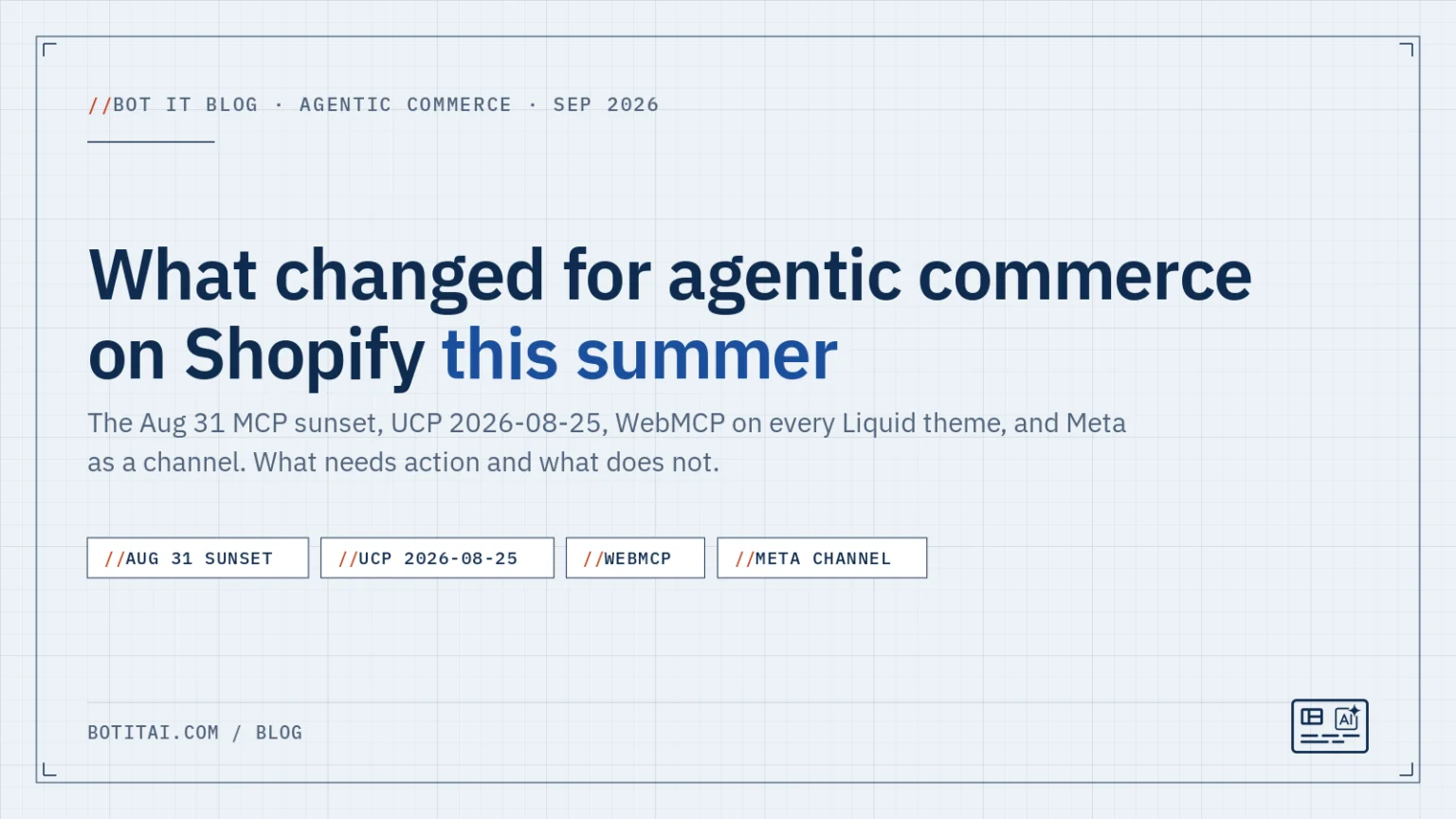
Between July and mid-September 2026, Shopify and the protocol groups around it shipped a run of changes to how AI agents find, read and buy from your store. Most of them landed without a notice in your admin. Some need nothing from you. A few deserve five minutes.
This is a digest for store owners, not developers. Each item says what happened, what it means for a merchant, and whether you need to act. Every date links to its source.
The timeline at a glance
| Date | What changed | Merchant action |
|---|---|---|
| Jul 21–22 | DotDev 2026: Catalog positioned as the foundation for agent shopping | None |
| Aug 5 | WebMCP native on every Liquid storefront | None |
| Aug 5 | Q2 results: AI traffic and orders 3x year over year | None |
| Aug 24 | Script tags deprecated (writes stop Oct 1, execution Mar 1, 2027) | Check your older apps |
| Aug 25 | UCP version 2026-08-25 released | None |
| Aug 31 | Storefront MCP cart tools on /api/mcp sunset | Only if you run a custom agent |
| Sep 2 | Claude Commerce Agents blueprint, with a Shopify example | None |
| Sep 4 | Shopify storefronts advertise UCP 2026-08-25 | None |
| Sep 8 | Meta added as an AI channel in Agentic Storefronts | Review the toggle |
| Oct 1 | API 2026-10: typed barcodes with validation | Clean up bad barcodes |
August 31: the Storefront MCP cart tools went away
Shopify announced on June 24 that the cart tools on the legacy Storefront MCP endpoint, get_cart and update_cart, were deprecated with an August 31 sunset. The sunset happened on schedule. We checked live stores on September 14: the legacy endpoint now lists a single tool, search_shop_policies_and_faqs. Catalog search, carts and checkout all live on the UCP endpoint at /api/ucp/mcp, documented under Cart MCP.
One loose end: the policies and FAQ tool was never deprecated and has no UCP successor. A developer spent two days confirming that on the Shopify community forum without a reply from staff. It still works. There is no announced date for it to stop.
What it means for you. If agents reach your store through Shopify’s own channels, nothing changed. If you or a vendor built a custom agent against the old endpoint, it stopped adding to carts on August 31. Bot It’s MCP enrichment proxy was moved to the UCP endpoint in July, so stores using it were unaffected.
Fig. 01 Where the Storefront tools live now
The legacy endpoint before and after the August 31 sunset, as listed by live stores on September 14.
BeforeUntil August 31
/api/mcp
get_cartupdate_cartsearch_shop_policies_and_faqs/api/ucp/mcp
catalog searchcartcheckoutAfterSeptember 1 onward
/api/mcp
get_cartupdate_cartsearch_shop_policies_and_faqsOne tool left. Never deprecated, no UCP successor, no announced end date.
/api/ucp/mcp
catalog searchcartcheckoutDocumented under Cart MCP. Where every agent that shops through Shopify goes.
Only a custom agent built against the old endpoint noticed. Bot It’s enrichment proxy moved to the UCP endpoint in July.
August 25 and September 4: UCP 2026-08-25
The Universal Commerce Protocol, the standard Shopify and Google use for agent discovery and checkout, published version 2026-08-25. It is a breaking release for implementers. The signing_keys array was removed in favor of a root-level keys set, payment extensions moved namespaces, and version matching became strict.
Ten days later Shopify began advertising the new version on every storefront’s manifest at /.well-known/ucp, with the note that capabilities are unchanged and no integration changes are required.
About “unsigned” manifests. If you have run an agent-readiness scanner, you may have seen a warning that your UCP manifest is unsigned. That is the platform default. Shopify does not sign merchant manifests. On the stores we checked, the manifest carries neither the old signing_keys nor the new keys. Signing is not enforced anywhere in the ecosystem today, and an August survey by UCP Checker found 10,409 verified Shopify storefronts with the same profile. An unsigned manifest is normal, not a defect you need to fix.
What it means for you. Nothing to do. Your manifest updated itself. If you want to confirm it, gate 4 in our store-level gates check shows what to look for.
August 5: WebMCP on every Liquid storefront
Shopify made WebMCP native on every Liquid storefront, with a preview for Hydrogen. WebMCP is a browser standard that lets an AI agent running in the shopper’s browser call named tools on the page instead of scraping it. Your storefront now registers ten of them, including catalog search, product detail, cart, checkout and the policies tool. There is nothing to install and no setting to turn it on. The documentation notes it is limited to a Chromium origin trial for now, and merchants cannot opt out.
What it means for you. Browser-based agents see the same product data the Catalog does. If a record is missing a category or attribute, it is missing in both places. The fix is the same: explicit product data.
September 8: Meta is a channel now
Shopify added Meta as an AI channel inside Agentic Storefronts. Your products are shared with it by default through Catalog, and direct checkout can be managed per channel. The official channel list in the Agentic Storefronts help center is now ChatGPT, Google AI Mode and Gemini, Microsoft Copilot, and Meta.
Two clarifications that come up often:
- ChatGPT is a discovery and referral channel, not a checkout. OpenAI dropped its in-chat Instant Checkout in March; Shopify’s admin now labels ChatGPT a “discovery-focused referrer platform.” A shopper who finds you in ChatGPT completes the purchase on your store. What you can influence there is whether you are chosen, and that is a product data question.
- Perplexity is not an admin channel. Several third-party posts list it as one. Shopify’s own post says data reaches Perplexity through Catalog. There is no toggle for it.
Fig. 02 The AI channels in Agentic Storefronts, September 2026
Each admin channel has its own toggle. Perplexity is often listed as one and is not.
ChatGPT
Discovery and referral. The purchase completes on your store. Shopify’s admin calls it a “discovery-focused referrer platform”.
Toggle in adminGoogle AI Mode and Gemini
Google’s assistants, fed through Catalog.
Toggle in adminMicrosoft Copilot
Fed through Catalog.
Toggle in adminMeta
Added September 8. Shared by default through Catalog; direct checkout managed per channel.
New, review the togglePerplexity
Reaches your data through Catalog. Shopify’s own post says so. There is no admin channel for it.
No toggleChannel list per the Agentic Storefronts help center. These toggles are not readable by any app, so this is a check only you can do.
What it means for you. Open Settings, then Sales channels, then Agentic Storefronts. Confirm the Meta toggle reflects what you want, and decide whether direct checkout should be on for any channel. These toggles are not readable by any app, so this is a check only you can do.
September 2: Claude Commerce Agents
Anthropic released an open-source blueprint for shopping and merchant agents. Shopify published a matching example within two days that uses UCP catalog search, Sign in with Shop and hosted checkout. An independent read of the blueprint found the shopping agent ranks on title, brand, category, attributes, option values and short description, and that inconsistent units across products cause filters to be dropped.
What it means for you. Another consumer of the same data. No consumer Claude shopping feature launched with it. The reference tells you what to fill in.
Three smaller items
Script tags. Shopify deprecated script tags on August 24. Apps can no longer create or update them after October 1, 2026, and they stop running on March 1, 2027. If you use an older app that injects storefront scripts this way, ask the vendor whether they have moved to theme app extensions or web pixels.
Typed barcodes. API version 2026-10, stable October 1, replaces the single barcode field with a list of typed barcodes (UPC, EAN, ISBN, GTIN, ASIN), validated for length, prefix and check digit. Invalid codes will become write errors. If your catalog has placeholder or hand-typed barcodes, this is the quarter to clean them.
The Q2 numbers. On August 5 Shopify reported AI-driven traffic and orders up 3x year over year, with 75% of AI orders outside the top 100 categories. The channel is growing and it is long-tail.
What needs no action, and what does
No action: the MCP sunset (unless you run a custom agent), UCP 2026-08-25, WebMCP, the Claude blueprint, the unsigned manifest warning.
Worth five minutes: review the Meta toggle and direct checkout settings in Agentic Storefronts; ask older app vendors about script tags; plan a barcode cleanup before October 1.
Worth an afternoon: the thing every one of these changes has in common. Each new surface reads the same product record. Explicit category, attributes, a literal title, specs near the top of the description. That work carries across ChatGPT, Copilot, Gemini, Meta, browser agents and whatever ships next. If you want the background, start with how Shopify Catalog ranks products and then how to set category attributes at scale.
Fig. 03 Nine changes, sorted by what they cost you
Everything in this digest, ranked by the time it asks of a store owner.
Every new surface this summer reads the same product record. The last row is the one that pays across ChatGPT, Copilot, Gemini, Meta, browser agents and whatever ships next.
If you want to see where your store stands on the store-level gates and the product data behind them, the Bot It audit is free to run on the full catalog, and the Pro plan applies the fixes at the automation level you choose, with every change revertible.