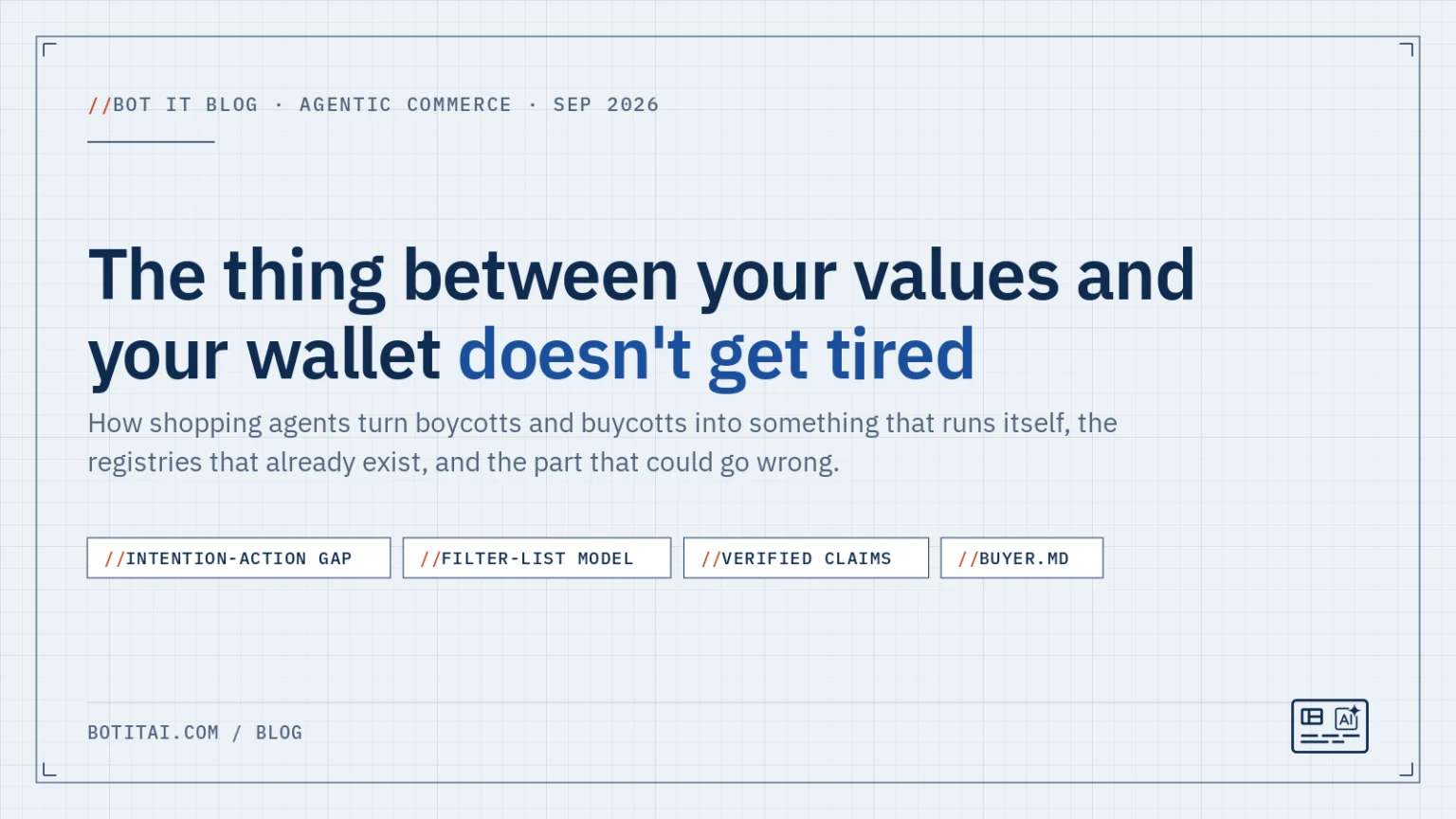
Shopping agents will make consumers more empowered to vote with their wallets. Here’s the mechanism, the infrastructure that already exists, and the part that could go wrong.
Say you decide you’re done with a big online retailer. Maybe it was something their leadership did with money. Maybe it was how they treat their warehouse people. Doesn’t matter. You’re done, and you’d rather buy from the smaller shop that takes two extra days to ship.
Six months from now you’ll be back on their site. Not because you changed your mind. Because you needed a phone charger by tomorrow, they were the first result, and your card was already on file. The boycott didn’t fail on principle. It failed on memory.
Your shopping agent won’t forget. One line in a file you own, and every purchase routes to the smaller shop until you delete the line.
That’s the whole thesis. The rest of this piece is about what happens when a few million people can do that at once.
Activism runs on leverage
Marches are leverage. Lawsuits are leverage. Votes are leverage. But the two kinds that scare a corporation most are economic and collective, and consumer boycotts are supposed to be both.
In practice they’re neither. Most boycotts die in three weeks, not from lack of conviction but from lack of attention. Every checkout is a moment where a human has to do three things at once:
- Remember the boycott exists.
- Still care about it, right now, more than about price or convenience.
- Pay the switching cost on the spot: find the alternative, make a new account, wait longer.
Miss any one of the three and the boycott loses that purchase. Researchers call the distance between what people say they’ll buy and what they actually buy the intention-action gap. A 2019 Harvard Business Review piece cited a survey in which 65 percent of consumers said they wanted to buy from purpose-driven brands and about 26 percent actually did.1
Fig. 01 Where a boycott leaks
The intention-action gap in one survey, and the three things a human has to get right at every single checkout for the boycott to hold.
Every checkout, all three, or the purchase leaks
1
Remember
that the boycott exists, at the moment of purchase.
2
Still care
right now, more than about price or convenience.
3
Pay the switching cost
find the alternative, make an account, wait longer.
Survey figures as cited by White, Hardisty and Habib, “The Elusive Green Consumer,” Harvard Business Review, July 2019. The gap is attention, not conviction.
There’s a class dimension too. A 2026 study in the Journal of Consumer Psychology found lower-income consumers are significantly less likely to boycott, and the reason isn’t apathy. It’s a reduced sense of control, a lower belief that consumption can be used to change anything.2 Boycotting has always been cheaper for people with time and options.
Agents change the cost structure. Enforcement goes to zero. The agent pays the attention cost, every time, without getting tired or tempted by the one that ships faster. A boycott you set in March is still running in November. And it’s running just as hard for someone working two jobs as it is for someone with a Patagonia habit.
Individual to collective
An agent enforcing one person’s grudge is still one person. Collective leverage only shows up when a lot of agents subscribe to the same list.
We already have the model for this. It’s called an adblock filter list.
Nobody hand-blocks trackers. A few volunteers maintain a machine-readable list, hundreds of millions of browsers subscribe to it, and every site on the internet has to reckon with it. The maintainers have no money and no organization to speak of. They have a text file and a lot of subscribers.
Commerce campaigns will work the same way. An organization publishes a list: these brands, these parent companies, these products, for these reasons, with these alternatives. Your agent subscribes. Your neighbor’s agent subscribes. The list gets updated on Tuesday and by Wednesday every subscribed agent is enforcing the change. No email blast, no reminder, no relying on anyone to remember anything.
Fig. 02 The filter-list model, pointed at commerce
How an adblock list turns a few volunteers into leverage over every site on the internet, and the same loop with a campaign file and shopping agents.
1. Publish
An org posts a machine-readable list
Brands, parent companies, products, reasons, alternatives.
2. Subscribe
Agents subscribe by URL
Yours, your neighbor’s, a few million more. One click, once.
3. Update
The list changes on Tuesday
No email blast, no reminder, nobody has to remember anything.
Outcome
Enforced everywhere by Wednesday
Every subscribed agent applies the change at every checkout, for as long as the line stays in the file.
Adblock filter list, today
A few volunteers maintain a text file
Hundreds of millions of browsers subscribe
Every site has to reckon with it
Campaign list, next
An org maintains a campaign file
Subscribed shopping agents enforce it
Every merchant has to reckon with it
The maintainers of EasyList have no money and no organization to speak of. They have a text file and a lot of subscribers. That is the whole model.
The lists already exist. They’re just built for humans.
This isn’t speculative. The registries are already out there. They’re just built for a person with a phone in a grocery aisle.
Open Food Facts is the best example. It’s an open, crowd-maintained database of more than three million food products with a free API, feeding dozens of apps with ingredient, allergen, and environmental scoring data.3 Everybody eats. Everybody buys food. And the data is already in a format software can consume. Someone has even wrapped it in an MCP server so AI assistants can query it directly.
There are others. Ethical Consumer has maintained a boycott list since 1989. Goods Unite Us tracks corporate political spending by brand. Boycat checks products against campaign databases and suggests alternatives. Boycott Buddy maps brands to their parent companies, which turns out to be the hard part, since the brand you’re avoiding is usually owned by someone who owns twelve other things you’re not.
Every one of these is a barcode scanner or a browser extension. They ask you to do the work at the moment of purchase. Point them at an agent instead and the work disappears.
A marketplace of programs
Once campaign data is a thing agents subscribe to, publishing it becomes a competition.
Picture a conservation nonprofit publishing a JSON file. One section is their worst-offenders list. Another is brands using certified sustainable forestry in their paper products, with discount codes those brands offered specifically to the org’s subscribers. The org’s members subscribe once. Their agents avoid the bad list and prefer the good list, and the members get a better price on toilet paper for the trouble.
That’s a buycott. Buycotts are less toxic than boycotts, they build something instead of only punishing, and they give brands a reason to court the org. Agents make buycotts trivial because a preference is just a positive weight.
Two things fall out of this that I think are bigger than they look.
Affiliate routing. Affiliate links today are a marketing tool merchants tolerate. In an agent world, my agent shops normally and routes the commission to a cause I chose. Amazon ran a weak version of this for a decade: AmazonSmile gave half a percent of eligible purchases to a charity of your choice, Amazon controlled every part of it, and they shut it down in February 2023 because it had “not grown to create the impact” they hoped for.4 The agent version is merchant-agnostic, user-controlled, and works across every affiliate program at once. It also creates a fun problem: what does a merchant do when the commission is going to the org running a campaign against them? They’ll write an affiliate policy, which becomes one more machine-readable disclosure.
Campaign status. Historical boycotts fail companies as badly as they fail activists. Once you’re on the list you never come off, so why bother complying? A campaign file with a status field changes that. Active, negotiating, resolved, lifted. The day an org marks a company compliant, every subscribed agent lifts the exclusion. That’s an incentive corporations have never actually had from consumer pressure: a credible promise that it ends.
Two smaller things I’ll only flag. Campaigns become measurable for the first time: an org can see how many agents subscribe and how many exclusions lifted when a company complied, which is data no boycott has ever had. And there’s a capture risk: once a spot on a preferred-brand list is worth money, brands will try to pay for it, and a list that takes the money is an ad unit with a nonprofit logo on it.
Telling the merchant why
Merchants have never had good signal on why they won or lost a sale on values. Agents can fix that, but it takes two different channels, because there are two different situations.
When the agent buys, it can say why in the order itself. “You got this sale because you offered carbon-offset shipping.” Today the closest thing is an order note. Tomorrow it’s a structured field in the checkout payload, which the new commerce protocols have room for. A merchant reading a thousand of those a week knows exactly which of their initiatives are paying for themselves.
When the agent skips a store, the store never sees it. Nobody sends a note explaining a purchase that didn’t happen. But the campaign registry knows, because the agent checked the list before it skipped. So the org can aggregate it and tell the merchant directly: this many subscribed agents excluded you this month, here’s the reason, here’s what clears it. That’s a stronger message than a thousand individual notes, because it arrives with a count and an exit condition.
Fig. 03 Two channels back to the merchant
A sale the agent made and a sale the agent skipped travel by different routes. One arrives inside the order, the other can only arrive as a count.
The agent bought
Say why, in the order itself
A structured field in the checkout payload. Today an order note.
The buyer’s agent, one per order.
Which initiatives are paying for themselves, from a thousand of these a week.
The agent skipped
The store never sees it
The campaign registry, which the agent checked before it skipped.
The org, aggregated across every subscribed agent.
How many agents excluded them this month, the reason, and what clears it.
A message with a count and an exit condition is stronger than a thousand individual notes. It tells the merchant the size of the problem and the day it ends.
The store’s side of the ledger
None of this works if the agent can’t read what a store claims about itself. Climate initiatives, labor certifications, sourcing, ownership, political giving. Today that’s a PDF on an About page, if it exists at all.
The EU is fixing this by force, on two fronts.
The first is the Digital Product Passport, under the Ecodesign for Sustainable Products Regulation. It requires structured, machine-readable product data, typically JSON-LD with GS1 Digital Link, covering origin, materials, and environmental information.5 The central registry goes live this year, battery passports become mandatory in February 2027, and textiles and apparel follow.
The second is the Empowering Consumers for the Green Transition Directive, which applies from September 27, 2026. Generic claims like “eco-friendly” become illegal without a recognized certification behind them, and every sustainability label in the EU has to rest on a certification scheme whose compliance is verified by a third party independent of both the scheme and the seller.6 If you sell anything into Europe, the store-side format and the verification rule are being written for you whether you like it or not.
Which brings up verification everywhere else. A certification badge on your About page proves you know how to upload a PNG. I’d expect three layers to shake out, in rough order:
- Claims. Merchants stuff their JSON-LD with every cert they’ve got. Zero proof, but not zero value. In the EU a false structured claim is now a legal liability, and everywhere else, a lie that gets caught tends to end up on exactly the kind of list this article is about.
- Registry lookups. The cert body publishes a machine-readable list of who they’ve actually certified, and the agent checks the merchant’s claim against it. Most cert bodies already have a directory page. They just don’t have an API. This is the obvious near-term move and it’s where somebody should go build something.
- Signed attestations. The cert body issues a cryptographically signed credential the merchant hosts alongside its other well-known files. The agent verifies the signature. No lookup required, can’t be forged, expires on schedule. The standard for this already exists in W3C Verifiable Credentials, and the pattern is already in commerce protocols: UCP, which Google and Shopify shipped in January, forbids buyer-asserted signals and only accepts direct observation or independently verifiable third-party attestations.7 Same mechanism, pointed at values instead of fraud.
Fig. 04 Three layers of proof for a store’s claims
How an agent could trust what a merchant says about certifications, sourcing and giving, from cheapest to strongest. The bar is how much of each layer exists today.
1
Claims
The merchant lists every cert it has in its JSON-LD. Zero proof, not zero value: in the EU a false structured claim is a legal liability from September 27, 2026.
Proof: none. Cost: none.
2
Registry lookups
The cert body publishes a machine-readable list of who it certified. The agent checks the claim against it. Most cert bodies have a directory page and no API.
Proof: a lookup. Cost: an API per cert body.
3
Signed attestations
The cert body issues a signed credential the merchant hosts with its other well-known files. No lookup, cannot be forged, expires on schedule. W3C Verifiable Credentials is the standard; UCP already refuses buyer-asserted signals the same way.
Proof: a signature. Cost: issuer adoption.
The bars are a reading of the text, not a measurement: directory pages are common, directory APIs are rare, and signed credentials exist as a standard with few issuers. The middle layer is where somebody should go build something.
I’m not going to propose who builds the middle layer. The market can, should, and will. If you’re already doing it, tell me in the comments.
Whose agent is it?
Here’s the part that decides whether any of this happens the way I’ve described, or arrives as a watered-down version where your “values” are a settings toggle inside someone else’s app.
Sixty-six percent of US shoppers say they won’t let an AI make purchases for them, even for a better deal.8 People point at that number as proof this is all far off. I’d point out that in 1998 nobody would type a credit card number into a website for many of the same reasons. Trust follows infrastructure. It doesn’t lead it. And this time the infrastructure is arriving faster: the web took most of a decade to get from that to one-click, while ChatGPT alone went from nothing to roughly 50 million shopping queries a day in about two years.9
But the trust question is real, because the incentives of the agents you can use today are visibly not yours.
OpenAI launched ads in ChatGPT in February, dropped its Instant Checkout product in March, and by May had opened its ad platform to every US advertiser.10 Amazon’s Rufus, since folded into Alexa for Shopping, was found in one independent test to recommend Amazon-sold products in 83 percent of results and Amazon Basics in 41 percent, roughly six times what market share would justify.11 Amazon sells sponsored prompts inside the assistant, blocks outside AI crawlers from its catalog, and went to court against Perplexity over a shopping agent that touched its site.12
Fig. 05 The trust gap and the incentive gap
Shoppers do not trust agents to buy for them yet, usage is climbing anyway, and the agents on offer today visibly answer to someone else.
Trust follows infrastructure
66%
of US shoppers say they won’t let an AI make purchases for them, even for a better deal
Omnisend survey via TechRadar
~50M
shopping queries a day on ChatGPT, from zero in about two years
Modern Retail, Jan 2026
83%
of Rufus results recommended Amazon-sold products in one independent test
Retail Tech Innovation Hub, Jan 2026
41%
recommended Amazon Basics, roughly six times what market share would justify
Same test
None of that is scandalous, it is the business model. The question is how hard an ad-funded agent enforces your exclusion of a brand that is also its advertiser. The 50M figure derives from an OpenAI Economic Research estimate that roughly 2 percent of ChatGPT queries are shopping-related.
None of that is scandalous. It’s the business model. But ask yourself how hard an ad-funded agent is going to enforce your exclusion of a brand that’s also its advertiser. Ask how a marketplace’s agent handles a boycott of the marketplace.
The answer is that your values have to live somewhere the agent doesn’t own. A file you control, that any agent can read, that you can take with you when you switch.
The open-source personal agent world already works this way. OpenClaw, the project that went from zero to a couple hundred thousand GitHub stars this year, defines its entire behavior in a Markdown file called SOUL.md.13 Hermes Agent from Nous Research runs fully local on whatever model you pick. Sovereignty here isn’t a slogan, it’s a file format. (Worth noting that OpenClaw’s creator joined OpenAI in February and the project now lives in an OpenAI-supported foundation.14 The line between “local” and “big lab” is going to keep moving. Which is exactly why the file matters more than the agent.)
Doc Searls has been making the customer-side version of this argument for twenty years under the name VRM, and in August he wrote of UCP: “Solves for the seller, that is. Not for the buyer. Yet.”15 He’s right. The buyer’s side of the protocol is an empty slot. Somebody’s going to fill it.
The part nobody wants to say out loud
This machinery cuts both ways.
Politics and commerce have been merging for a decade. Agents finish the job. When a boycott costs nothing to enforce and never expires on its own, a small business can get crushed over one bad post by a list it doesn’t know it’s on, with no one to appeal to. Registry maintainers become political targets and kingmakers. Whoever runs the biggest campaign clearinghouse has a lot of quiet power.
I don’t have a fix. Open formats and federation help, because they mean no single list is mandatory and no single maintainer is the chokepoint. Expiration dates help, because they force campaigns to justify themselves again. Status fields help, because they let companies off. But anyone who tells you this is all upside hasn’t thought about it.
What the file might carry
I maintain an open standard for portable shopping preferences called buyer.md. It’s a Markdown file a person owns and any agent can read. Today it covers the ordinary stuff: sizes, budgets, delivery preferences, brands you like.
The version that supports what’s described here would need a few more things. Hard exclusions, the never-buy list. Soft avoidance with weights, for the brands you’d rather not but will if you have to. Preferred brands and preferred vendors, which are not the same thing and conflict more often than you’d think. Subscribed campaign lists, by URL, with a pinned version so an update can’t surprise you. Supported organizations for affiliate routing. A precedence rule for when all of that disagrees. And an expiration on everything, because a boycott that outlives your reason for it isn’t activism, it’s a habit.
On the other side, a campaign file would carry the target and its scope (brand, parent, vendor, product category), the reasons, evidence links, alternatives, a status, and a review date.
Fig. 06 Two files, two owners
What a person’s preference file and an org’s campaign file would each need to carry for the loop in this piece to work. A sketch, not a spec.
buyer.md
A person owns it
what it covers today, with delivery preferences and brands you like
Added for campaigns
the never-buy list, a hard rule
brands you’d rather not, but will if you have to
not the same as vendors, and they conflict
the shops you’d rather buy from
subscribed lists by URL, with a pinned version
organizations that receive routed affiliate commission
the rule for when all of the above disagree
on everything, so a habit cannot outlive its reason
campaign file
An org publishes it
who the campaign is about
brand, parent company, vendor, or product category
why, in words an agent can pass on
links that back the reasons
where the purchase goes instead
active, negotiating, resolved, lifted
when the campaign has to justify itself again
The status field is the part corporations have never had from consumer pressure: a credible promise that it ends. The day a company is marked compliant, every subscribed agent lifts the exclusion.
That’s a sketch, not a spec. Whether it lands in buyer.md or somewhere else matters less than that it lands somewhere a person owns.
Because the point was never that agents will shop for you. It’s that for the first time, the thing standing between your values and your wallet doesn’t get tired.
Sources
- White, Hardisty, Habib. “The Elusive Green Consumer.” Harvard Business Review, July 2019.
- Vieites et al. “Stratified consumer activism: How socioeconomic status shapes boycott participation.” Journal of Consumer Psychology, 2026.
- Open Food Facts. API documentation.
- TechCrunch. “Amazon ends charity donation program AmazonSmile.” January 2023.
- Packa. “Digital Product Passport for Packaging 2026: Data Standards, Interfaces, and the Roadmap to 2030.” One Click LCA. “Digital Product Passport: A guide for manufacturers in 2026.”
- Cooley. “Empowering Consumers for the Green Transition Directive.” March 2026. Sidley Austin. “New EU Directive Strengthens Consumer Protection Laws on Greenwashing and Circularity.”
- Universal Commerce Protocol. Specification overview, 2026-04-08.
- TechRadar, citing Omnisend survey. “Would you let AI make purchases for you? Two-thirds of us say no.”
- Modern Retail. “Why the AI shopping agent wars will heat up in 2026.” January 2026. Figure derived from an OpenAI Economic Research working paper estimating roughly 2 percent of ChatGPT queries are shopping-related.
- Marketplace Pulse. “Rufus, ChatGPT, and the Agentic Ad Convergence.” May 2026.
- Retail Technology Innovation Hub. “Rufus and the AI shopping war.” January 2026. CNBC. “Amazon ditches Rufus chatbot, launches Alexa shopping agent.” May 2026.
- Paz.ai. “Amazon Is Buying ChatGPT Ads. That’s Not a Strategy.” June 2026.
- Petronella Technology Group. “OpenClaw Tutorial: Self-Hosted AI Agent Build Guide.” July 2026.
- TechCrunch. “OpenClaw creator Peter Steinberger joins OpenAI.” February 2026.
- Doc Searls. “UCP needs VRM.” ProjectVRM, August 22, 2026.