
Tobi Lütke walked on stage at NRF in January with Sundar Pichai a few feet away and said something I haven’t been able to shake: “It’s really good at finding people who have specific interests and finding the product that is just perfect for them. Like, I would have never searched for this product, but somehow it found me right on the other side. This kind of serendipity is where the best of commerce happens.”
That’s not a product announcement. That’s a worldview. And it’s the same worldview I’ve been building toward, in one form or another, since 2005.
Here’s the through-line of my career. The buyer moves first. The merchant moves second. The gap between those two moves is where the money is.
In 2005, the buyer moved to Google. Most merchants were still printing flyers. I started Rainmaker Web Design because someone had to drag small businesses onto the web and make them rank. The gap was SEO.
Around 2017, the buyer moved to Shopify storefronts that loaded fast and merchandised themselves by behavior, not by alphabetical order. Most merchants were still hand-sorting collections in the admin like it was 1998. Scott and I built Dynasort. The gap was automated merchandising. Get your best stuff to show up first, automatically, across hundreds of collections.
In 2026, the buyer moved into AI chat. AI-driven traffic to Shopify stores has grown 8 times year over year, and orders from AI-powered searches have increased 15 times. Adobe Digital Insights found that AI-driven traffic to retail sites surged 693% year-over-year during the 2025 holiday season. Most merchants don’t know it’s happening. The gap is agentic readiness. That’s Bot It.
This is the third time in my career I’ve watched buyers walk through a new door while merchants kept polishing the old one. I’m not guessing this time. I’m betting on it.
What the big players are actually building
If you want to know where this is going, watch what Shopify, Stripe, OpenAI, and Google are standardizing, not what they’re marketing. Standards are where companies quietly admit what they expect the world to look like in five years.
In the last six months, four protocols crystallized into the agentic commerce stack:
- MCP (Model Context Protocol, from Anthropic), how agents discover and read external systems.
- ACP (Agentic Commerce Protocol), co-developed by Stripe and OpenAI, powers Instant Checkout in ChatGPT.
- AP2 (Agent Payments Protocol), Google’s open standard for cryptographically signed payment mandates between agents and merchants.
- UCP (Universal Commerce Protocol), co-developed by Shopify and Google, backed by Amazon, American Express, Etsy, Mastercard, Meta, Microsoft, Salesforce, Stripe, Target, Walmart, and Visa.
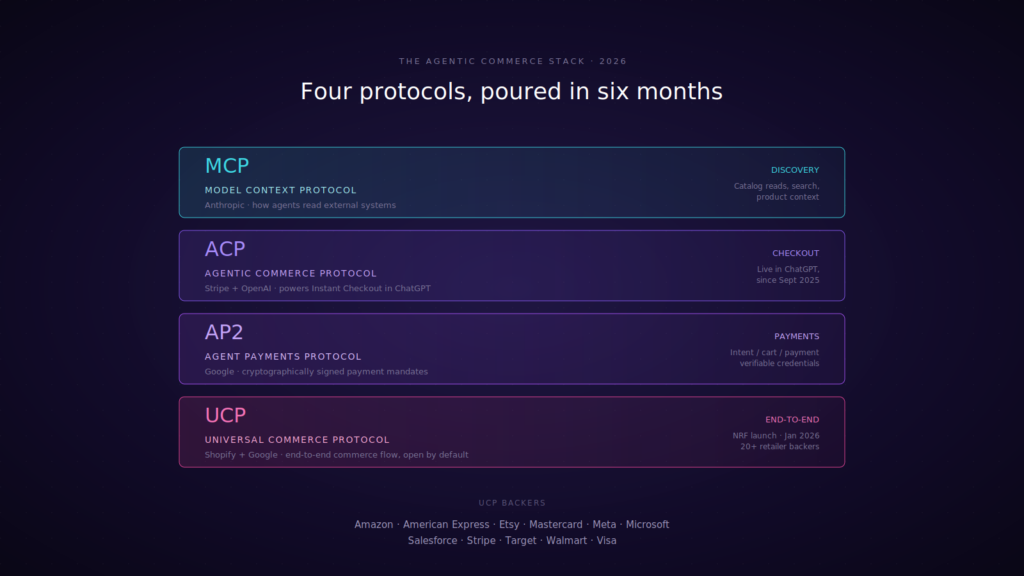
Read that backer list again. American Express, Mastercard, and Visa all signed onto the same agentic commerce protocol in the same quarter. That doesn’t happen in fragmented markets. That happens when the infrastructure is being poured.
And it’s being poured fast. Shopify activated Agentic Storefronts for millions of merchants in March 2026, giving them out-of-the-box access to ChatGPT, Microsoft Copilot, AI Mode in Google Search, and the Gemini app, managed centrally from the Shopify Admin. If you’re on Shopify and you sell to US shoppers, you’re already in ChatGPT, whether you’ve thought about it or not.
Here’s the part most people miss. Shopify is making connectivity free. Their native /api/mcp ships with every store. Their Catalog API indexes every merchant. UCP is open by default. “It’s open by default, so platforms and agents can use UCP to start transacting,” as Tobi put it on X the day UCP launched.
Connectivity is becoming a commodity. That’s the bet I’m staking my career on. And it changes what the moat is.
What’s actually missing
Let me show you, in concrete terms, what the current stack does not solve. This is where the next decade of opportunity sits.
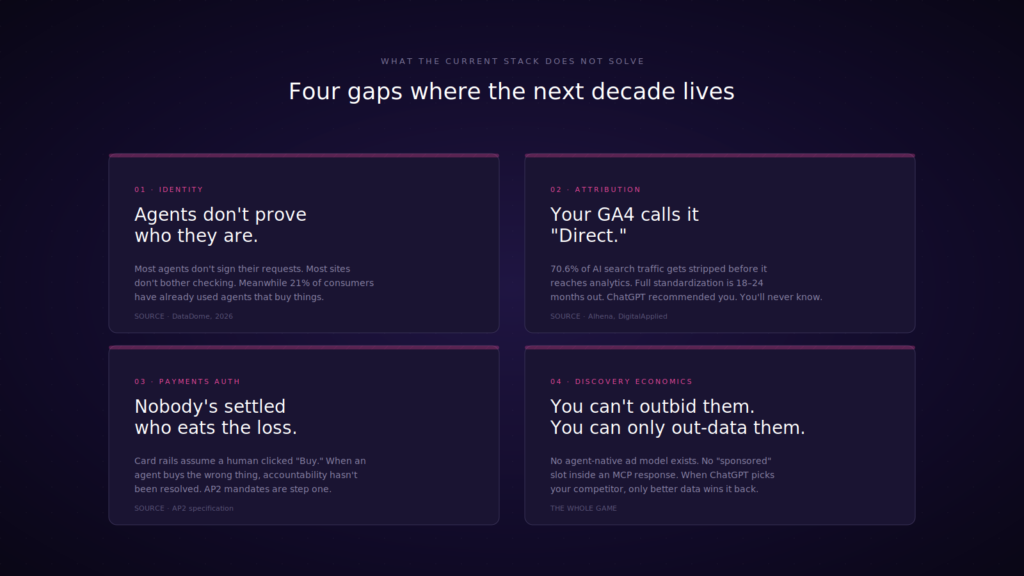
Agent identity is a mess. DataDome’s research from early 2026 found that most agents don’t prove who they are and most websites don’t bother checking, while 38% of consumers now use tools like ChatGPT for product research and 21% have used agents that make decisions or purchases automatically. Web Bot Auth is emerging, but adoption is early, and even verified agents can be socially engineered into doing dumb things.
Attribution is broken. 70.6% of AI search traffic gets stripped before reaching your analytics. Your GA4 dashboard sees a sale and labels it “Direct.” You have no idea ChatGPT recommended you. Server-side webhook capture is the only real fix, and full attribution standardization is 18 to 24 months away.
Payments authorization is unsolved at scale. The AP2 spec is blunt about why it exists: today’s payment infrastructure assumes a human is present to approve every purchase. When autonomous agents act on a user’s behalf, fundamental questions arise that current systems are ill-equipped to answer: authorization, authenticity of intent, agent error and “hallucination,” and accountability. Card networks are still figuring out who eats the loss when an agent buys the wrong thing.
Discovery economics don’t exist yet. There’s no agent-native ad model. No “sponsored result” inside an MCP response that anyone agrees on. When ChatGPT recommends your competitor instead of you, you can’t outbid them. You can only out-data them.
That last one is the whole game.
Why I built Bot It
Shopify’s native MCP gives agents your products, your prices, your inventory. Table stakes. What it doesn’t give agents, and what Shopify has explicitly said is the merchant’s job, is the part that makes your store yours.
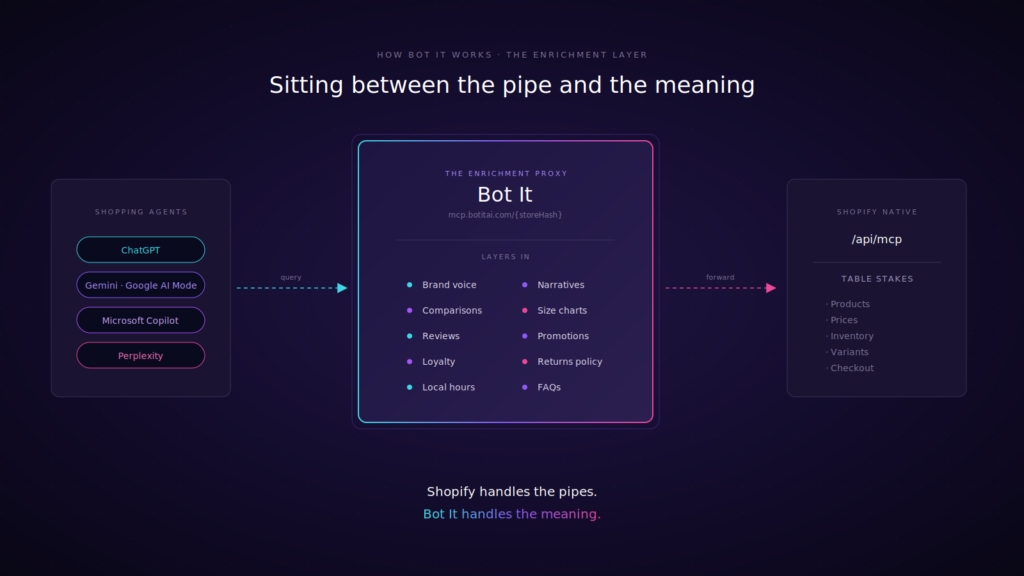
Shopify’s own positioning: “We’re making every Shopify store agent-ready by default. Shopify is the easiest solution for merchants who want AI agents to find their storefronts, understand their products, and complete transactions.” The platform handles the pipes. The merchant has to handle the meaning.
That’s the layer I’m building. Bot It sits in front of Shopify’s /api/mcp as an enrichment proxy. When an agent asks about a product, we intercept, we enrich, and we forward. We layer in the brand voice the merchant actually wrote. The narrative around the product. The size chart, the review summary, the comparison against the competitor SKU, the agent-targeted promotion, the loyalty program, the return policy, the local store hours. Everything Shopify’s native MCP doesn’t, and probably won’t, hold.
Then we measure what happened. Which agent asked. What they searched for that we didn’t have an answer for. What countries the demand is coming from. Whether we even ship there. Whether Shopify’s native MCP went down for our merchant this morning. We score how an agent sees the store. A Bot Score, run against an AI Simulator that queries the store the same way Claude or ChatGPT would.
We also built nine browser-based MCP tools as a theme extension for the WebMCP standard Chrome is rolling out. Nobody’s using them yet. Adoption is months away. We built them anyway, because I’ve been here before. Building for SEO in 2005 looked premature too. Building for collection merchandising in 2017 looked premature too. The merchants who waited until the buyer wave was obvious never caught up.
Some of this will get absorbed by Shopify. That’s fine. Connectivity will. Enrichment, analytics, and merchant-curated narrative won’t, because Shopify can’t write your brand voice for you, and they’ve explicitly said they won’t try. “You decide where and how your brand shows up from discovery to post-purchase.”
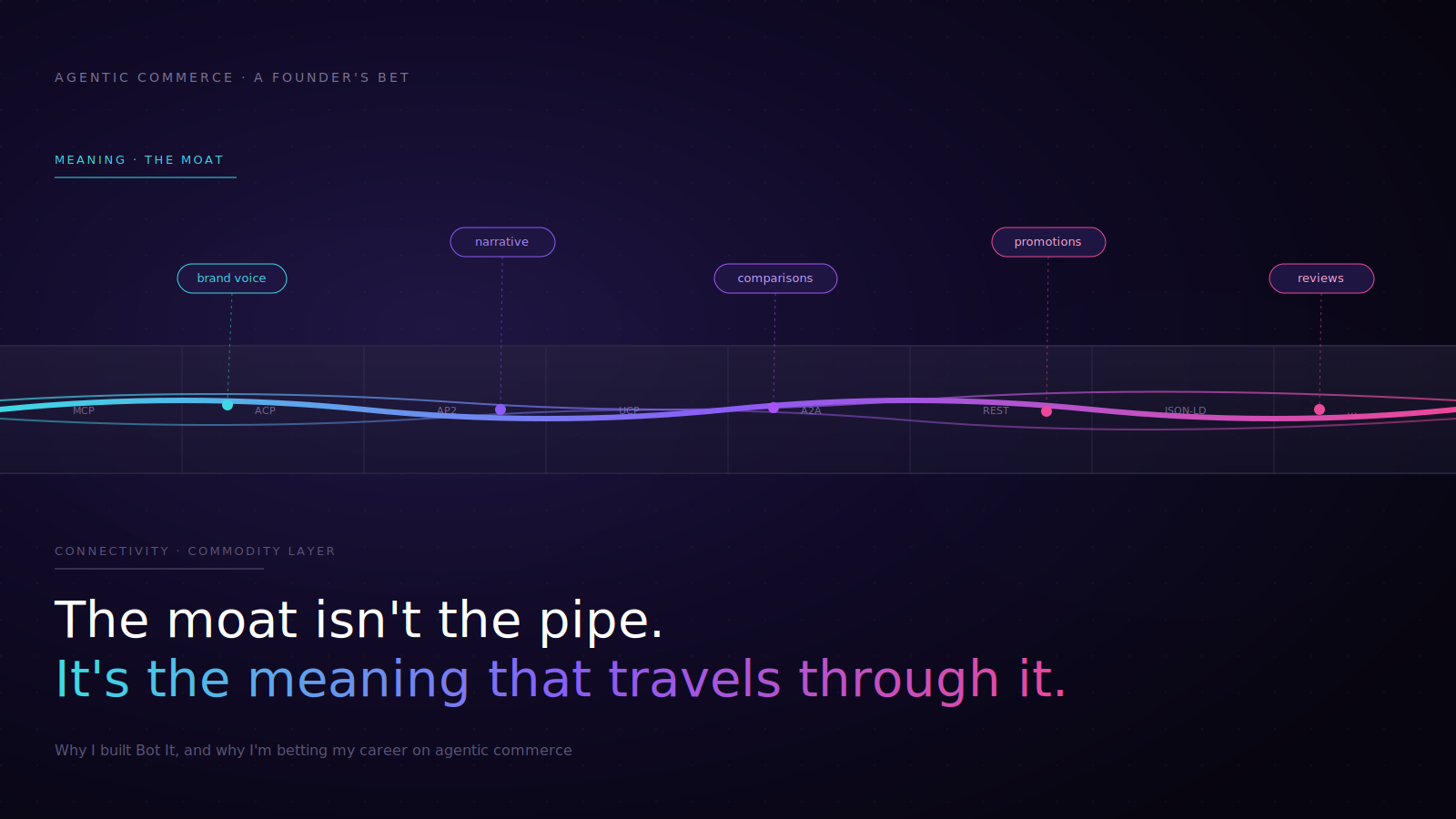
That’s the moat. Not the pipe. The meaning that travels through the pipe.
The bet
McKinsey estimates the global agentic commerce opportunity could reach $3 trillion to $5 trillion by 2030. I’m not going to pretend I know if that number is right. What I know is that Tobi described it as “a new cambrian explosion of creativity in shopping,” every major card network signed onto the same protocol in the same quarter, and ChatGPT, Gemini, Copilot, and Perplexity are all racing to own the conversation that used to start on Google.
The buyer has already moved. They’re inside the chat. Tatcha is now attributing 11.4% of total site revenue to AI, with 3x conversion rates and a 38% lift in AOV. That’s not the future. That’s already in their P&L.
Most merchants will spend 2026 the way they spent 2005. Hoping the new channel won’t matter, then hoping someone builds them an app for it.
Seventeen years of e-commerce taught me that the gap between when the buyer moves and when the merchant moves is the only window that actually pays. SEO paid that bet. Dynasort paid that bet. I’m convinced Bot It will pay it again, because the buyer is already through the door and most merchants haven’t even noticed.
I’d rather be early and right than late and certain.
Sources
- Shopify Winter ’26 Edition / Agentic commerce announcement: https://www.shopify.com/news/ai-commerce-at-scale
- Shopify on how agentic commerce works: https://www.shopify.com/blog/how-agentic-commerce-works
- Shopify Agentic Storefronts announcement: https://www.shopify.com/news/winter-26-edition-agentic-storefronts
- Shopify on Agentic Commerce momentum (March 2026): https://www.shopify.com/news/agentic-commerce-momentum
- Stripe + OpenAI Instant Checkout / ACP launch: https://stripe.com/newsroom/news/stripe-openai-instant-checkout
- ACP spec on GitHub: https://github.com/agentic-commerce-protocol/agentic-commerce-protocol
- Google AP2 announcement: https://cloud.google.com/blog/products/ai-machine-learning/announcing-agents-to-payments-ap2-protocol
- AP2 specification: https://ap2-protocol.org/specification/
- TechCrunch on UCP launch (Tobi serendipity quote): https://techcrunch.com/2026/01/11/google-announces-a-new-protocol-to-facilitate-commerce-using-ai-agents/
- GeekWire on Google UCP / Adobe 693% stat: https://www.geekwire.com/2026/google-makes-a-big-move-into-agentic-commerce-raising-questions-about-amazons-retail-dominance/
- Tobi Lütke X post (cambrian explosion): https://x.com/tobi/status/2003586628145807568
- Tobi Lütke X post (UCP launch): referenced via https://www.thekeyword.co/news/google-launches-universal-commerce-protocol-to-connect-ai-agents-with-retailers
- DataDome on AI agent identity crisis: https://datadome.co/threat-research/ai-agent-identity-crisis/
- Alhena AI on LLM traffic attribution gap: https://alhena.ai/blog/llm-traffic-attribution-ai-search-revenue/
- DigitalApplied on AI agent commerce revenue attribution: https://www.digitalapplied.com/blog/ai-agent-commerce-revenue-attribution-guide-2026
- Tatcha case data via Alhena: https://alhena.ai/blog/shopify-ai-chatbot-roi/
- McKinsey $3-5T figure cited via Shopify: https://www.shopify.com/blog/agentic-commerce